This is from my book Coat Hangers and Knitting Needles probably the most painful book I have ever written. Listening to the stories of the women I cried over and over. We thought the fight was over, but now women are dying again because of laws usually made by men who will never have to face an unwanted pregnancy with no good solutions.
Chapter 27
Jane Roe vs. Norma McCorvey
Weddington promised to take care of her, she(McCorvey) said.
Being “taken care of” was a phrase she used in more than one interview.
22 January 1973
My daughter was four that day. I had slept at my mother’s, not just to celebrate my child’s birthday but because my sister-in-law, a hairdresser, was in a competition. She had asked me to be her model because my red hair would stand out on the stage.
I had rushed around trying to find the right outfit to match the hairstyle she was creating. I found a full-length, navy-blue, Victorian-era-style dress.
We didn’t win. But we did hear the Roe v. Wade Supreme Court decision announcement.
I had not been a furious campaigner for abortion rights, although I’d done a few pro-choice marches. I’d spent more time lobbying during my lunch hour at the National Fire Prevention Association for the Boston legislature to try to pass the Equal Rights Amendment. The State House was only a few blocks away from my office, and I felt a great deal of pride whenever I entered the building. My grandfather had done much of the engineering on a reconstruction of the gold dome.
As a divorced woman, trying to raise a child, I was aware of the many disadvantages I had as a woman, including my smaller paycheck than the men at the same level with less experience. Still I had made it into lower management.
Many of my friends had sought illegal abortions dangerously in back alleys or safely through the Clergy Consultation Service (CCS). At the time I thought the CCS operated just in Massachusetts. Only when writing this book did I realize that it was nationwide.
Roe v. Wade was a victory for the safety of women’s health. The victory was eclipsed the next day by Richard Nixon’s announcement of “peace with honor” in Vietnam, which brought neither peace nor honor.
I didn’t pay much attention to the court details except:
- It was a seven-to-two ruling
- The 14th amendment supported a woman’s right to privacy in deciding to have an abortion balanced against the state’s interest
I had no idea who the real Jane Roe was. Only decades later did I learn that her real name was Norma McCorvey. Nor did I know the names of the attorneys Sarah Weddington and Linda Coffee. I was grateful to them, because I knew abortions would happen, legal or not, and now any woman who needed one for any reason would be able to have the procedure without the fear of dying.
Norma Leah McCorvey
My opinion of the need for legal abortions has been constant. McCorvey changed her point of view. Jane Roe, aka Norma Leah McCorvey (September 22, 1947-February 18, 2017), went from being the poster child for the pro-choice movement to the poster child for the pro-life movement.
Why such a huge change?
I was determined to find out more about her.
Coat Hangers and Knitting Needles is not an academic book, but that does not mean I have license to be inaccurate.
The internet makes research much easier and gives me access to sources I might not otherwise have. I do not/did not need to travel to libraries and statehouses around the U.S. I’ve ordered many books both online and in print. I could access news sources and television programs that even if I were doing an academic book 20 years ago would not have been available then.
The internet has several interviews with Norma McCorvey which helped me learn more about her and her transformation over the years (see the bibliography).
McCorvey was born in Simmsport, Louisiana, a town of 2.4 square miles. The 2017 population is under 3,000 people. The family eventually moved to Houston, Texas.
Her childhood was probably traumatic. Her father left her with an alcoholic mother when McCorvey was 13, but she had already had problems with the law after she stole money from a gas station.
Her lesbian tendencies surfaced when still a minor when she rented a room for her and another girl, her lover.
She claimed that the happiest time in her life was when she was at the State School of Girls in Gainesville, Texas between ages 11 and 15. During one of her stays at her home she said she was raped by her cousin repeatedly.
She met her husband, Woody McCorvey, seven years her senior, and married him when she was 16.
In her autobiography, I Am Roe, she was open about her lesbian relationship with Connie Gonzales. Later she claimed she was no longer a lesbian.
Won by Love was her second book, published in 1998.
She became a Christian and her 8 August 1995 baptism was filmed and broadcast. It showed a happy woman.
McCorvey began to work with Flip Benham and Operation Rescue, which was founded in 1986 to stop abortions and fight for anti-abortion legislation.
Because of her change of opinion, McCorvey could no longer work in an abortion clinic. “I was wrong,” she said.
Her attempt to undo Roe v. Wade in McCorvey v. Hill, filed in 5th District Court, failed. Under the Federal Rules of Civil Procedure, a person can file for relief from judgment. The Court ruled too much time had elapsed (30 years) as of 14 September 2004. The Supreme Court did not take the case.
McCorvey died of heart failure at the age of 69 in Katy, Texas.
She was a complex human being with shifting opinions, needs and emotions.
Hardtalk
BBC’s Hardtalk was and is one of my favorite news interview programs. The former presenter, Tim Sebastian, a seasoned, multi-lingual journalist, is as comfortable working in the Middle East, Europe or Asia and hosted Hardtalk for many years. He interviewed many world leaders and presented top quality news programs and debates.
If I were guilty of anything, I would not want to be his guest. The cliché of a cat pouncing on a mouse works. If any of his interviewees strayed from the truth or evaded his answers, he verbally pounced and played with them until they either admitted what they had done wrong or discredited themselves by the obviousness of their lies.
His interview in 2004 with Jane Roe/Norma McCorvey was different. At some point he seemed to realize, that unlike a politician, a dictator or a corrupt businessman, McCorvey was … was…it is hard to find the word. Damaged seems unkind. Limited might be better. Her sincerity came across, and Sebastian had interviewed enough morally challenged people or outright liars to recognize the difference.
Kind isn’t a word I would use for him as an interviewer, but I will forever hold him in awe how he balanced “kind” and still managed an in-depth interview.
He introduced the program like this: “When it comes to the legal history of the United States, the case of Roe v. Wade is one the greatest landmarks in 1973 and has been challenged by opponents ever since. Ironically one of them is the original Jane Roe who was cited in the original case. She has now turned aside that pseudonym. She’s turned full circle against that ruling and wants the ruling overturned. What happened to change her mind?”
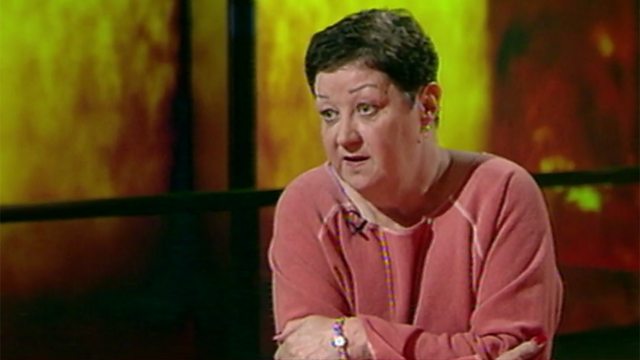
McCorvey sat at a round table to the right of Sebastian. Maybe three feet separated them. The background of Hardtalk’s regular red and gold set glowed. McCorvey leaned toward her host with her arms crossed in front and clutching her elbows.
Sebastian gave his usual, “A very warm welcome to the program.”
Under his questioning she described herself as “being from the wrong side of the tracks” and the girl mothers didn’t want their daughters to play with.
She’d had a rough childhood and an unhappy adult life.
She told about drinking heavily. When she found herself pregnant for a third time, she went to a doctor, who told her about two young lawyers who wanted to challenge the abortion law. They were Sarah Weddington and Linda Coffee, who would bring the case before the Supreme Court.
McCorvey described their meeting as drinking beer after beer. Phrases like “control your own body” were tossed around. She thought it sounded good. Weddington promised to take care of her, she said. Being “taken care of” was a phrase she used in more than one interview.
In another interview, she chided Weddington for having an abortion in Mexico, but not helping her do the same. When McCorvey gave birth to the baby, she gave it up for adoption. She said that she resented that she wasn’t smart enough or beautiful enough to be a spokesperson at a Washington, D.C. rally. “I was misled,” she told Sebastian.
Sebastian, who usually went for the jugular in interviews, treated her gently, while pointing out some of the inconsistencies in her responses.
One example: He asked her if she voted for George Bush. She had.
Earlier she stated she was against the death penalty, but she seemed to be unaware that Bush had overseen many executions in Texas. McCorvey admitted she wasn’t a regular voter.
When asked about abortion being allowed to save the life of a mother, she hesitated. Earlier she had said that she was against abortion under any circumstances.
“You say you are a Christian now and you never were before. Do you think Christianity is incompatible with abortion?” he asked.
“Abortion is killing and in the 10 Commandments it says thou shall not kill. I agree with the 10 Commandments and all the teaching of the Catholic Church,” she said.
“Specifically, with the Catholic church?” he asked. “With any church who believes abortion is wrong.”
“The Church of England says the situations where the continuance of the pregnancy threatens the life of the mother a termination of pregnancy may be justified and there must be adequate and safe provision in our society of such situation.”
McCorvey said the decision should be up to the priest or the woman’s husband.
“And not the woman?” Sebastian asked. His tone was one of seeking information not challenging.
“If she is able,” she said. “I don’t have all the answers, Tim.” She also pointed out she didn’t go to church in England.
She talked about her work at an abortion clinic where she said she saw babies ripped from the mother’s womb. She claimed doctors only wanted the money and would rush off to play golf after performing the procedure, leaving the women bleeding. Abortion kills women, she said, but she had no statistics to back up her statements. Sebastian did not challenge her in his usual method except to say there were “chinks of light” in her no-abortion-under-any-circumstance belief.
When McCorvey said that there were still women dying in the United States from legalized abortion, Sebastian asked, “How many?”
“We’re talking about thousands.” “Where do you get these figures from” “I have no basis for them, okay?”
In a touching moment, McCorvey held out her scarred wrists from her suicide attempts. “What are you showing me?” Sebastian’s voice was soft. His eyes met hers and never left her face as she described her four suicide attempts. The reason, she said, was her name being tied to the Roe v. Wade decision that she described in another television appearance as being responsible for three generations of death.
She admitted she lied in saying she was raped. Her pregnancy was the result of an affair. But she also expressed her belief that her lawyers had lied to her. “I was told by Sarah Weddington and Linda Coffee that if abortion was made legal in Texas it would put an end to rape and incest. It didn’t happen. There is just as much rape going on…”
“Are you saying you were misled by your lawyers?” Sebastian asked.
“Yes, I am.”
“In 1983 you were quoted in a book called The Law Giveth (by Barbara Milbauer) talking about Sarah Weddington…”
“Who was she?” McCorvey interrupted referring to the author.
Sebastian pointed out that McCorvey had described Weddington as a good listener, a very gracious lady and knowing her was better than knowing the queen.
“I must have been stoned when I said that.” She was laughing when she made that respo
nse.
She talked about misquotes but didn’t say that particular statement was a misquote.
At the end Sebastian expressed his usual thanks.
Note: This is from my book Coat Hangers and Knitting Needles probably the most painful book I have ever written. Listening to the stories of the women I cried over and over. We thought the fight was over, but now women are dying again because of laws usually made by men who will never have to face an unwanted pregnancy with no good solutions.


 Posts


No comments:
Post a Comment